In May 2026, Ghana’s Cyber Vetting and Enforcement Team arrested people over AI deepfake videos that impersonated President John Dramani Mahama. The arrests came only weeks after Ghana launched its National AI Strategy on 24 April 2026. The videos looked real and sounded real, and that was the point. We explain that video scam in If You Saw the President Ask for Money, Would You Believe It? Ghana’s New AI Deepfake Scam Problem.
That case was about video, but the same problem now covers still images and written text too. There was a time when an AI generated image was easy to spot. The hands had too many fingers. The text in the background was gibberish. That time is ending. The newest tools produce work that often looks real at a glance.
This matters because if you cannot tell whether an image or a piece of writing is real, you cannot decide whether to trust it. That affects news, health advice, product reviews, job offers and messages from people you know. The old advice, look closely and you will see the flaws, is no longer enough. What is needed is a set of checks that work together.
What Is Actually Happening
AI generated content is content made by a computer program trained on very large amounts of existing text, images and video. The program learns patterns from that data, then uses them to make something new. When you type a short instruction, called a prompt, an image tool can produce a photo like picture of a market in Accra. A text tool can produce an essay, a news report, a job advert or a message that sounds as if a person wrote it.
These tools are often called generative AI. Generative means they create new content, rather than simply finding content that already exists. Many are free or cheap, and they work on an ordinary phone or laptop. That is why the amount of AI made content online has grown so fast.
A picture or a piece of writing can now arrive on your phone with no clear sign of how it was made. It may have been made by a person, by a machine, or by a person who used a machine to help. Often, the person who shares it does not know either. That is how a fake image of a flood, a fake quote, or a fake job advert can travel across WhatsApp and Facebook before anyone has checked it.
What Still Works, For Now
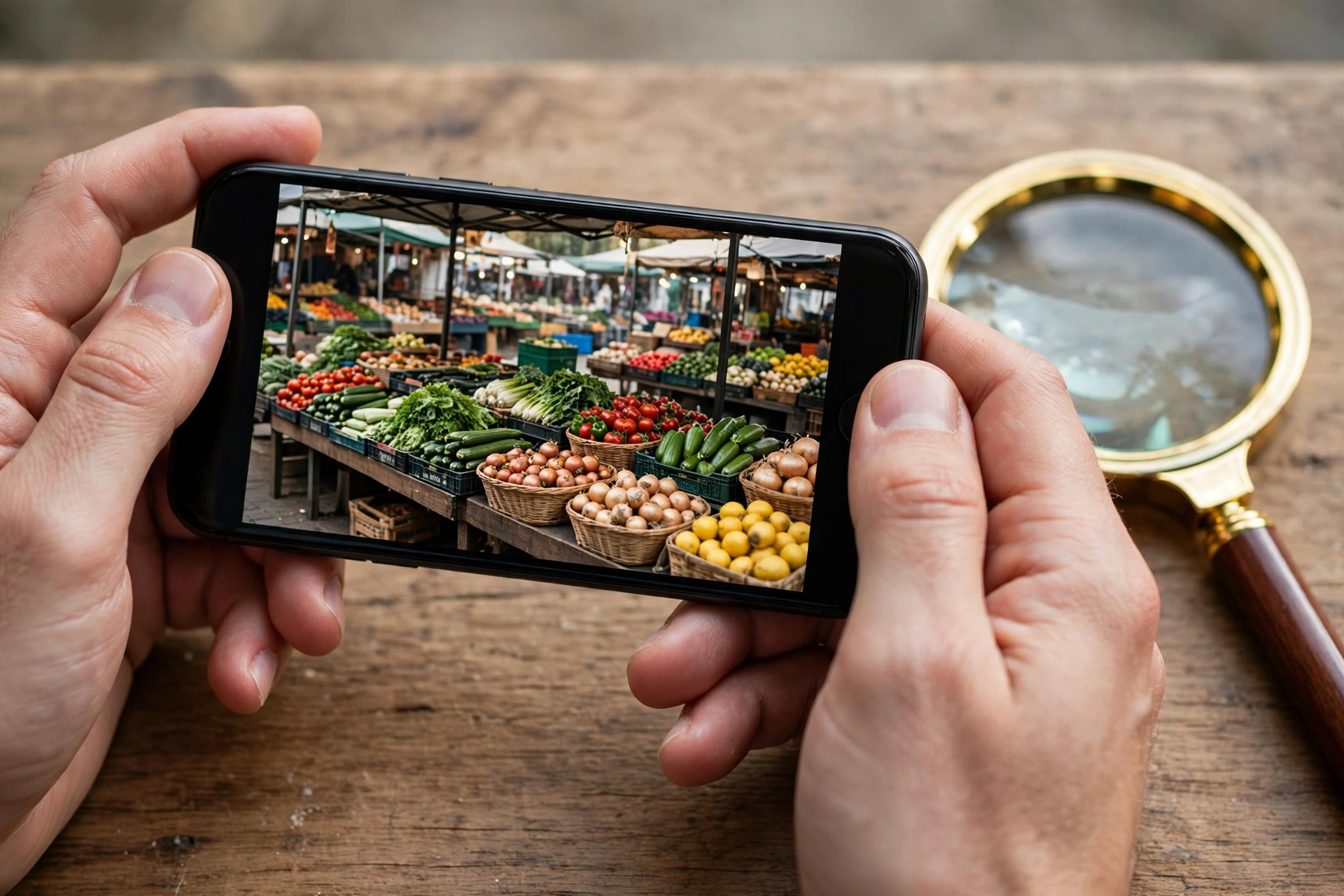
There are still clues, and they are worth knowing. In images, look closely at hands, ears and teeth, which remain hard for generators to draw well. Look at text inside the image, such as signs and labels, and ask whether it is legible and makes sense. Look for patterns that repeat in unnatural ways, such as identical windows or faces that are too symmetrical. Look at the background too, where objects may melt into each other and shadows may fall in the wrong direction.
In text, look for writing that is fluent but vague. AI generated writing is often full of confident general statements and short on concrete detail you can check. It may give no names, no dates, no places and no numbers you can verify, and it may repeat the same point in slightly different words. Human writing is often messier.
There are also technical checks. Some AI tools attach a label to what they make, such as a visible label, a hidden mark, or a signed record of where the file came from. That record is often called provenance, which simply means the history of where something came from. The open standard for this record is called C2PA, short for the Coalition for Content Provenance and Authenticity. Google also uses an invisible watermark, called SynthID, which changes the pixels in a pattern the eye cannot see but a detector can find. If a label is present, it is useful evidence. If it is absent, it proves nothing, because a screenshot or a re-upload can remove it.
These clues help, but none of them is proof on its own. A real photo can have odd lighting. A real piece of writing can be vague. A synthetic image can be nearly perfect.
Why This Is Different
Detection is getting harder because the tools are now trained on far more data, and they have learned the patterns that used to give them away. The newest models produce hands with the correct number of fingers, text that is mostly legible, and faces that stay consistent from one angle to another. The flaws that remain are subtler, and they need a more careful look than most people give a post as they scroll past it.
Detection tools are also imperfect. The software that claims to tell you whether an image or a piece of text was AI generated gives both false alarms and misses. MIT Technology Review has reported that the tools for spotting AI generated text are still weak against the newest chatbots. Relying on a single detector is a mistake.
AI made content is also mixed into everyday life now. Banks in Ghana already use AI for fraud detection, chatbots and credit scoring, as we explain in From National Ambition to Bank Floor: Closing Ghana’s AI Adoption Gap in Financial Services. Newsrooms, marketers, students and scammers all use the same tools. You cannot judge a picture by where you found it. You have to judge it by what you can check about it.
Who Is At Risk
Everyone who reads news or messages on a phone is at risk, but some people face a higher risk. Older people and people who are new to smartphones may trust a photo or a voice message more readily, because they grew up when a photo was strong proof. Young job seekers are at risk from fake job adverts and fake recruiters who use polished AI written messages to look like a real company. Traders are at risk from fake product photos, fake reviews and fake adverts for goods that do not exist.
People who follow politics are also at risk. A fake image, a fake quote, or a fake news report can spread quickly during an election or a crisis. Anyone who sends money online is at risk too. A fake image or message can be the first step in a scam that ends with a mobile money payment. Our guide, How Mobile Money Fraud Actually Works in Ghana, and How to Not Be the Next Victim, explains how those payment scams work.
The risk is not that people are careless. The tools have become good enough to fool careful people too. The defence is not a sharper eye. It is a slower habit, the habit of pausing before you believe or share.
What Ghanaian Law Says
Ghana does not yet have a dedicated AI law. The National AI Strategy, launched on 24 April 2026, is a policy, not a law. It sets out what the government wants AI to do for Ghana over ten years, but it does not by itself create new offences or new rights for victims.
What does apply is the Data Protection Act 2012, Act 843. This law governs how personal data, which means information about a real person, such as their name, face, voice, phone number or photo, may be collected and used. Using a person’s face or voice to make a fake image or video without their permission can breach that law.
Fraud is also covered by existing criminal law. If a fake image or fake text is used to trick someone into sending money, that is fraud, even if AI was used to make it. Report online scams and impersonation to the Cyber Security Authority. You can call or text 292, send a WhatsApp message to 0501603111, or email report@csa.gov.gh.
What To Actually Do: A Practical Checklist
Use these checks together, not one by one. No single check settles the question, but together they give you a much better chance.
- Pause before you share. If a post makes you angry, afraid or excited, that feeling may be the point. Wait, and check before you pass it on.
- Check the source, not just the picture. Who posted it first? Is it an official account, a known news outlet, or an unknown account?
- Run a reverse image search. Upload the image to Google Lens and see where else it appears. A distinctive phrase from a piece of text can be searched in the same way.
- Look for provenance. Check whether the file carries a Content Credentials record, a C2PA label, or a platform label that says it was made with AI. Upload the original file, not a screenshot, because a screenshot can strip the record away.
- Ask whether the claim can be checked elsewhere. A real event is usually reported by more than one credible source. If only one unknown account reports it, treat it as unproven.
- Look for the old clues, but do not stop there. Check hands, ears, teeth and shadows in images. In text, look for vague claims and no names or dates.
- Use a detection tool as a starting point, not a verdict. If the tool and your own checks disagree, keep digging.
- When in doubt, do not share. Sharing gives synthetic content its power. Pausing breaks the chain.
Conclusion
The ability to spot AI generated content is becoming less about having a sharp eye and more about having a disciplined habit. The habit is to pause, to check the source, to verify the claim, and to resist the urge to share something simply because it confirms what you already believe. That habit is not a technical skill. It is the most reliable defence we have as the line between real and synthetic continues to blur.
The tools will keep improving, and the fakes will keep getting better. For now, remember the simple rule. If you cannot check where it came from and whether it is true, do not treat it as true, and do not share it.
Sources Referenced
- MIT Technology Review, How AI-generated text is poisoning the internet, 20 December 2022. https://www.technologyreview.com/2022/12/20/1065667/how-ai-generated-text-is-poisoning-the-internet/
- MIT Technology Review, Why Big Tech’s watermarking plans are some welcome good news, 13 February 2024. https://www.technologyreview.com/2024/02/13/1088103/why-big-techs-watermarking-plans-are-some-welcome-good-news/
- FIRST, CERT-GH, Cyber Security Authority reporting channels, call or text 292, WhatsApp 0501603111, email report@csa.gov.gh. https://www.first.org/members/teams/cert-gh
- Guide to Artificial Intelligence, What are content credentials and AI watermarks? https://www.guidetoartificialintelligence.com/en/learn/content-credentials-ai-watermarks/
- Saviour Amevor, If You Saw the President Ask for Money, Would You Believe It? Ghana’s New AI Deepfake Scam Problem, Academia, July 2026. https://academia.edu/resource/work/171059598
- Original draft 31151, How to Actually Spot an AI-Generated Image or Piece of Text, and Why It’s Getting Harder, August 2026. Source listed in the original draft: MIT Technology Review, 12 June 2024, https://www.technologyreview.com/2024/06/12/1093383/ai-generated-images-detection/ (plain text only, do not hyperlink this URL)