
Introduction
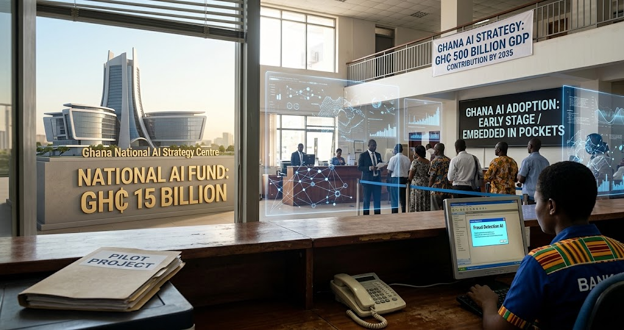
On 24 April 2026, President John Dramani Mahama launched Ghana’s first National Artificial Intelligence Strategy in Accra. AI means computer systems that can learn from data and do tasks that used to need a person, such as spotting fraud or answering a customer. The plan runs from 2025 to 2035. It is backed by a National AI Fund that starts at 5 billion cedis and grows to 15 billion cedis by 2035, plus 250 million dollars for a national AI Computing Centre. The plan says AI should add 200 billion cedis to Ghana’s economy by 2030, and 500 billion cedis by 2035. GDP is the total value of goods and services a country makes in a year.
The bank floor tells a different story. AI in Ghana banking is still at the early stage, in small pockets, not across the whole bank.
What the National AI Strategy Actually Promises
The National AI Fund starts at 5 billion cedis for 2025 to 2030, and then grows to 15 billion cedis for 2030 to 2035. The 250 million dollars for the AI Computing Centre was approved by Cabinet. At the launch, the President said the centre would be a nerve centre for research, innovation and enterprise.
One figure needs care. Some reports give a total of 270 million dollars. That is the 250 million dollars for the centre, plus 20 million dollars for short term work to get the plan started. The plan also aims to create 500,000 new jobs in digital services and AI work over ten years.

The Eight Pillars, in Plain Words
The strategy is built on eight pillars, or main areas of work. First, expand AI education. Second, give young people the skills for the jobs of the future. Third, deepen digital infrastructure and inclusion. Infrastructure means the basic systems AI needs, such as computers, internet and power. Fourth, make data access and governance better. Governance means the rules that decide who can use data, and how. Fifth, build a strong AI community. Sixth, speed up AI use across sectors, which are parts of the economy such as health, farming, or banking. Seventh, invest in applied AI research, which is study done to solve a real problem. Eighth, promote AI use in the public sector, which is government and the services it runs.
Yet the plan does not single out banking as a priority sector. Most of its detail is about education, public sector work, and basic systems, not about how a bank should use AI day to day.
What Is Actually Happening With AI in Ghana Banking
KPMG released its 2025 West Africa Banking Industry Customer Experience Survey, which covers banks in Ghana and Nigeria. It is based on answers from over 35,000 retail customers, 5,000 small and medium firms, and 600 large firms. A retail customer is an ordinary person who banks as an individual.
Its key finding is simple. In Ghana, AI in banking remains at an early stage. AI is already in use, but in pockets, not woven through the whole bank. A pilot is a small test of a new idea, before it is used more widely. Many banks have pilots. Few have moved from a pilot to a system that runs across the whole bank, every day. The gap is between a funded national plan and what is actually running inside a bank.
The Complaint Test
Only 33 percent of customers across the survey reported being satisfied with the time taken to resolve a complaint. A complaint is a good test of a bank. It shows how fast a bank listens, finds the problem, and fixes it.
AI can help here. Triage means sorting a problem first, so the right person or system deals with it fast. Where AI is already in use, the leading uses are fraud detection, chatbot customer service, and credit scoring. Fraud detection means using AI to spot a payment or a login that looks wrong. A chatbot is a computer program that answers customer questions in writing, at any hour. Credit scoring means using data to judge how likely a person is to pay back a loan. These uses are real, but they are often separate. They are not yet joined up into one system.
Why AI in Ghana Banking Is Different
AI in a bank is not just a faster computer or a new app. It changes how a decision is made. In the old way, a person read a form and decided. With AI, a system reads the data and suggests a decision.
First, AI uses customer data at scale, which means for very large numbers of people at once. A mistake in one case is bad. The same mistake in ten thousand cases is a serious harm. Second, AI can be hard to explain. A customer who is refused a loan has a right to know why. If the answer is that the computer said so, that is not good enough. Third, AI changes the work of staff. A worker who used to check forms by hand now has to check what the AI did, spot its errors, and deal with the hard cases it cannot solve. So this is a change in how a bank decides, explains, and takes responsibility.
Who Should Care
Banks should care first. A bank that cuts fraud losses, or answers complaints faster, can show the value of AI in a way that a workshop cannot. For example, if a bank cut fraud losses by 20 percent, that would be a clear result. That is an example, not a fact.
Customers should care too. AI can mean a faster answer, a safer account, and a fairer loan decision. It can also mean a wrong decision that is hard to challenge, or personal data used in a way a customer did not expect. The customer needs to know how to ask for a human review.
Workers should care, because their jobs will change. Some routine checks will move to AI. New work will appear in checking AI and helping customers with hard cases. Small businesses should care as well, because a small firm that waits weeks for a loan loses money and time. If AI makes credit decisions faster and fairer, small firms gain. If it makes decisions that no one can explain, small firms lose out first.
CISD 2026, Explained in Plain Words
The Bank of Ghana launched a revised Cyber and Information Security Directive in March 2026. It is called CISD 2026 for short. CISD means the rules from the Bank of Ghana on how banks and other financial firms must protect their computers, their data, and their customers from online harm. The 2026 version replaces the 2018 version, because the old rules no longer fit the risks of 2026.
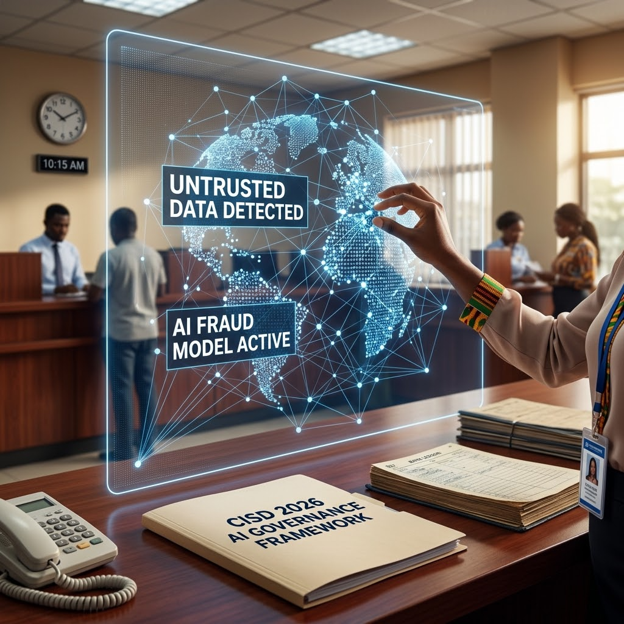
CISD 2026 applies to banks and to other firms the Bank of Ghana regulates, including fintechs, microfinance firms, and payment firms. A fintech is a firm that uses technology to offer money services, often on a phone. The directive has six pillars. The first is AI and machine learning governance. Machine learning is a type of AI that learns from data. Banks must be open and fair when they use AI for fraud detection, credit scoring, and customer service. The other pillars cover cloud security, rules that fit each firm, board accountability, and active defence. Cloud means computer services that run over the internet. In plain words, a bank using AI must show it is safe, fair, and under control.

Why Banking Should Be Watched First
Banking is better placed than almost any other sector in Ghana to show whether the national AI plan works. It has customer data, digital systems, high transaction volumes, and a clear business reason to improve. Banking also has the basic systems already in place. Mobile money works across networks, payments move in seconds, and most customers now use a smartphone.
What is missing is systematic AI on top of those systems, for fraud, credit access, and customer service at scale. If banks get this right, other sectors can learn from them. If they get it wrong, the harm will be felt fast.
What Actually Closes the Gap
National funding alone does not turn into AI that works across a whole bank.
- Partner with the National AI Fund, with a clear plan for banks. Agree a share of funding and clear milestones with dates, so progress can be checked.
- Invest in skills tied to real work. Staff need to learn how to govern and check AI systems that touch credit, fraud, and customer data.
- Build AI with CISD 2026 in mind from the start. Treat AI governance as a design rule, not as a check after the system is already live.
- Publish progress, and measure it the same way each year. Repeat the KPMG benchmarking, and ask the Bank of Ghana to publish AI adoption figures with its annual report.
- For customers, ask for a clear answer. If a bank uses AI to decide on a loan or a fraud check, ask how the decision was made, and how to ask for a human review.
- For workers, learn to check AI, not just to use it. Ask for training in how to spot an AI error and help a customer when it gets it wrong.
Conclusion
Ghana now has one of the more ambitious and better funded national AI plans on the continent, and a banking sector with the systems, the data, and the business reason to make it real. The distance between the two is not funding. It is execution, which means doing the work, step by step, and checking the result. That work will be done, or not done, on the bank floor, one real system and one measured result at a time.
Sources Referenced
- Republic of Ghana National Artificial Intelligence Strategy 2025 to 2035, Ministry of Communication, Digital Technology and Innovations, launched 24 April 2026. Launch date, ten year period, eight pillars, National AI Fund 5 billion cedis to 15 billion cedis, AI Computing Centre 250 million dollars, GDP targets 200 billion cedis by 2030 and 500 billion cedis by 2035.
- GhanaFact, 28 April 2026, Ghana’s National AI Strategy launched: Key points you need to know. Fund timing, 5 billion cedis for 2025 to 2030 and 15 billion cedis for 2030 to 2035, GDP targets, 250 million dollars for the AI computing centre, eight pillars and 73 policy recommendations.
- AdwumaTech, Ghana’s National AI Strategy: What It Means for Institutions. Eight pillars listed in plain form, Fund seeded at 5 billion cedis and scaling to 15 billion cedis, Cabinet approval of the 250 million dollar computing centre.
- Business and Financial Times, via GH Headlines, 30 April 2026, Ghana’s defining pairing: The National AI Strategy and the Pan African AI Summit. Total of 270 million dollars, made up of 250 million dollars for the computing centre and 20 million dollars for short to medium term work.
- KPMG, 2025 West Africa Customer Experience Banking Survey, Competing for the Customer, Beyond the Basics in an AI-Shaped Financial Landscape. Survey based on over 35,000 retail customers, 5,000 small and medium firms, and 600 corporates in Ghana and Nigeria.
- Bank of Ghana, Cyber and Information Security Directive, March 2026, CISD 2026. Revised directive replacing the 2018 version, six pillars, including AI and machine learning governance, cloud security, proportionality, and board level accountability. Launched in Accra in March 2026, Governor Dr Johnson Asiama.
- TechFocus24, Bank of Ghana unveils new cyber directive with six pillars to shield financial sector from rising digital threats. Six pillars of CISD 2026, including AI governance for fraud detection, credit scoring, and customer service, and at least one board member with proven cyber risk skill.
- Original WordPress draft 31125, From National Ambition to Bank Floor: Closing Ghana’s AI Adoption Gap in Financial Services, last modified 29 August 2026. Source for the 500,000 new jobs figure, the 33 percent complaint satisfaction figure, the four closing steps, and the Bank of Ghana 2024 Annual Report listing. Those figures were kept as in the original draft.










6 Comments