

The government of Ghana is offering free training in coding and digital skills to one million people. The programme is called One Million Coders. It was launched on 16 April 2025 at the Ghana-India Kofi Annan Centre of Excellence in ICT in Accra. The aim is to train one million Ghanaians over four years, with 400,000 people in 2026 alone.
That is a large promise. The question most people ask is simpler. How do I join, what will I actually learn, and what certificate do I get at the end? This guide answers those three questions in simple words, with the real numbers so far, and with an honest look at where the programme is working and where it is still slow.
What Is Actually Happening
One Million Coders is the government’s main digital skills programme. It is run by the Ministry of Communication, Digital Technology and Innovations. It is part of President John Dramani Mahama’s RESET agenda. The training is free. You do not pay to register, and you do not pay for the lessons.
The programme started small. In the pilot phase in 2025, it trained 859 people. More than 90,000 people applied for that pilot, and about 94,000 applications arrived within the first 48 hours. Just over half of the pilot trainees, 52 percent, were women.
Training for the main rollout began on 1 May 2026. It runs at 130 learning centres across all 16 regions of Ghana. The government presented 8,500 laptops on 11 April 2026 to support the rollout. Of those, 6,500 went to the 130 centres and 2,000 went to 12 universities. In January 2026, the Minister said 20,000 laptops had been procured in total for the programme.
Registration for Phase 2 opened on 25 April 2026. Phase 2 training started on 11 May 2026.
The latest official numbers come from the Ministry, with data to 2 August 2026. By that date, 141,954 people had registered. Of those, 27,782 were active learners, and 5,812 had completed a course. The Minister later said in September 2026 that completions had passed 10,000. That gap between registrations and completions is the honest picture. Many people sign up. Far fewer finish a course. That is normal for free online learning, but it is the number to watch.
Who Can Join
The programme is open to students at participating universities and institutions, and to any other Ghanaian who wants to learn. If you are not a student, you can still register on your own. You do not need a degree, and you do not need to know how to code already. The programme is built for beginners as well as for people who already have some skill.
Two things are needed to register. The first is a Ghana Card. The second is an email address you can access, because the programme will send updates and course details to that email. You can add your educational certificates if you have them, but they are not required.
At the University of Ghana and KNUST, the programme is compulsory for Level 100 students. Your university will give you instructions if that applies to you. The Ministry has signed agreements with 11 universities, including the University of Ghana, KNUST, the University of Energy and Natural Resources, the Ghana Communication Technology University and the University of Cape Coast, to add digital certifications into degree and diploma courses. On 9 November 2026, the Minister said at a meeting in Doha, Qatar, that 11 universities had begun to add One Million Coders certification into their academic programmes.
What You Learn
The programme does not teach one course. It teaches several tracks, and you choose one. The most popular track so far is cybersecurity, with 8,570 learners as of August 2026. The other main tracks are data analytics, artificial intelligence, project management, network support, data analysis and data protection. Earlier courses also covered web development and Python, which is a coding language used widely in data work and AI.
That list matches what employers are hiring for. Our guide to the IT skills employers want most in Ghana in 2026 names the same five areas: AI, cloud computing, cybersecurity, data analytics and automation. One Million Coders is one way to learn the first three of those without paying for a course.
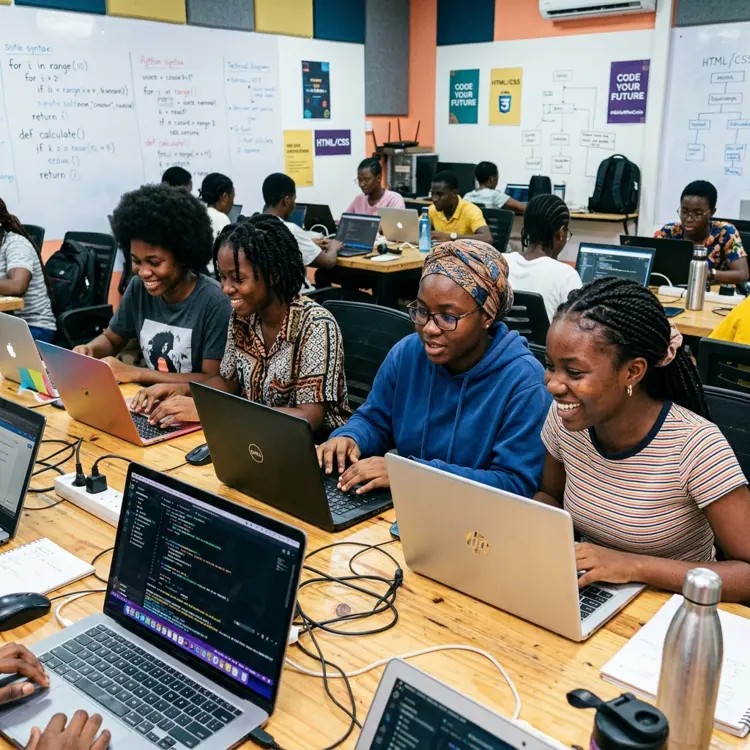
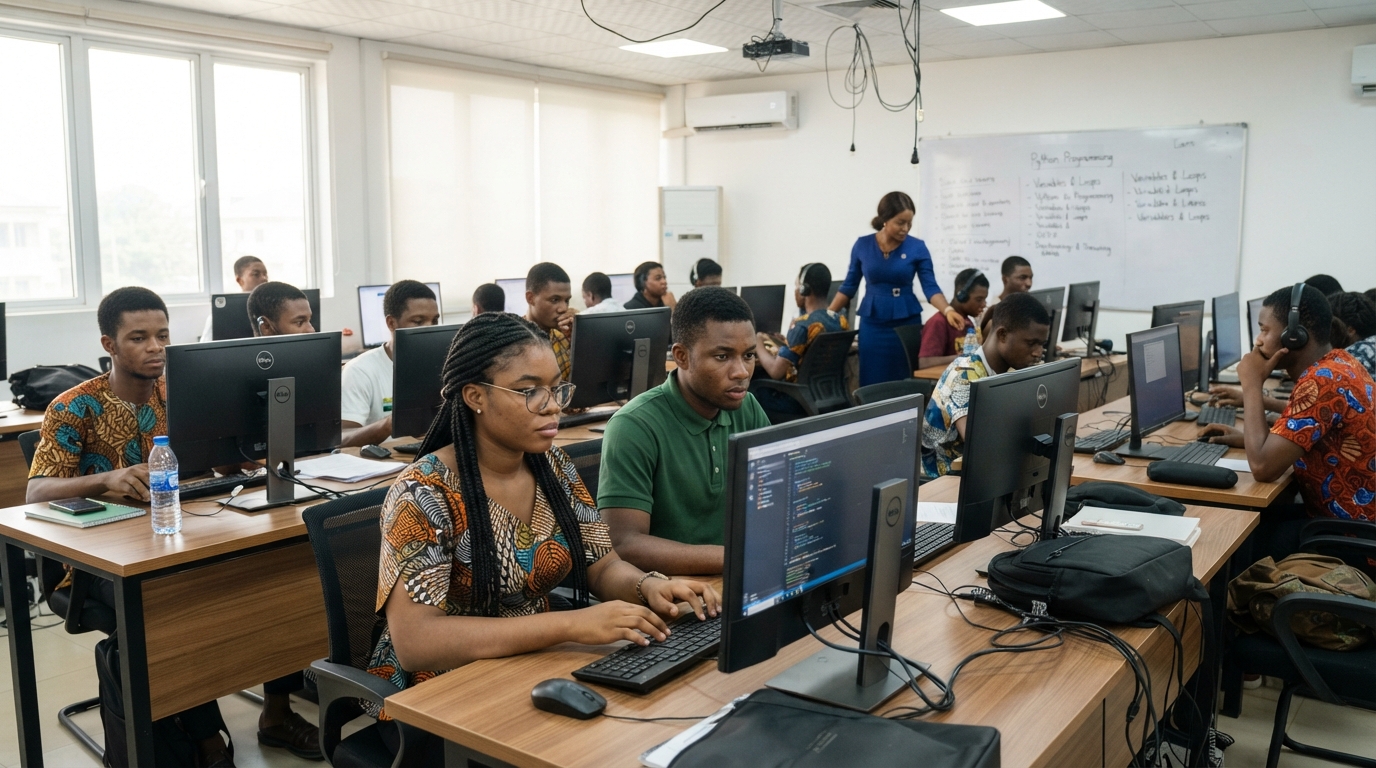
You can learn in two ways. The first is self-paced online learning, where you study on your own time on a phone or a computer. As of August 2026, 24,394 learners were studying this way. The second is centre-based learning, where you go to a training centre and learn with support from a trainer. About 6,050 learners needed centre-based support. If you do not have a laptop or steady internet at home, centre-based learning is the better choice.
The programme is also working with the Ghana Education Service on basic digital skills for young people aged 13 to 19. That work is separate from the main adult training, and it is still being set up.
How to Join, Step by Step
Registration is only on the official portal. The address is onemillioncoders.gov.gh. Do not register through a WhatsApp link, a Facebook post or a person who says they can register you. Registration is free, so anyone who asks you for a fee is not acting for the programme.
Here are the steps for a new applicant.
- Go to onemillioncoders.gov.gh on your phone or computer.
- Choose to register. The portal has a page called How to Register.
- Enter your details and verify your identity with your Ghana Card.
- Confirm your email address. You will get a message to check that the email is yours.
- Log in and choose your course, for example cybersecurity, data analytics, AI or networking.
- Choose how you want to learn: self-paced online, or at a training centre if that is offered in your area.
If you registered in Phase 1, you do not need to register again. Log in with the account you already have and choose your courses when the Phase 2 portal is active for you.
If you are a student at a partner university, follow your university’s instructions first. The Ghana Communication Technology University, for example, has its own registration guide on its website.
If you need help, the portal lists the support email support@onemillioncoders.gov.gh. Use the email on the portal itself, not a number from a social media post, because more than one number has been shared online and not all of them are official.
What Certificate You Get
There is no single One Million Coders certificate. Each track ends with its own certificate, and the certificate depends on the course you finish. The training is given with global technology firms, including Huawei, Google, MTN, AWS, Oracle and Telecel. Telecel has committed to give free access to its Startocode learning platform to train 100,000 young Ghanaians over four years. MTN Ghana announced a 2 million dollar investment in the programme in January 2026.
That matters because a certificate from a name employers know carries more weight than a certificate from a name they have never heard of. But a certificate on its own rarely wins a job. Our guide to free certifications worth getting before you pay for one makes the same point. A certificate plus a small project you can show, such as a simple website, a data report or a security checklist you built yourself, is a much stronger signal than a certificate alone.
Check the portal for your track before you start, so you know which certificate that track gives, and whether it comes from the programme itself or from a partner such as Huawei or Google. Do not trust a social media post that promises a specific certificate or a job at the end. No course can promise you a job.
Why This Is Different
Free government training in tech is not new in Ghana, but the scale of this programme is new. One million people over four years is far larger than any earlier scheme. The programme also links training to certificates from global firms, and it links those certificates into university courses. That link between a free government programme and a university degree is the part that could last longest, even after the four years end.
The programme is also honest about its own slow start, and that honesty matters. Reports in 2026 raised real concerns. In November 2025, the programme’s website was reported as not working, with no valid security certificate. In March 2026, critics pointed to the gap between 859 people trained in the pilot and a target of 400,000 in a single year. In September 2026, the Ministry itself said the main problem was a shortage of trainers, not a shortage of applicants.
The response to that problem is now under way. From 31 August to 4 September 2026, the Ministry ran a five day Training of Trainers course at the Kofi Annan Centre, with experts from Huawei. Each person who finished that course is expected to train at least 20 members of the public afterwards. That is how a programme with too few teachers tries to grow more teachers.
The test for the rest of 2026 is simple. Can the programme turn registrations into completions, and can it do it in all 16 regions, not only in Accra and Kumasi? The target of 400,000 people in 2026 will not be met by sign-ups alone. It will be met only if people finish what they start.
Who Is Actually at Risk
The main risk is not the programme itself. It is the people who copy it. Because One Million Coders is free and popular, scammers use its name. They send WhatsApp messages and Facebook posts that promise a place on the programme, a certificate, or a job, and they ask for a fee or for your Ghana Card details.
The rule is simple. The programme never asks for a fee. Registration is only on onemillioncoders.gov.gh. If someone asks you to pay to register, or to send money on MoMo to secure a place, it is not the programme. Do not send the money, and do not share your Ghana Card number with a stranger on WhatsApp.
The second risk is time. A free course that you start and never finish costs you nothing in money, but it costs you the months you could have spent learning one skill properly. Our guide on how to break into tech without a computer science degree makes the same point. Pick one track, finish it, and build one small project to show what you learned, before you start a second course.
What to Actually Do: A Checklist
- Go to the official portal only: onemillioncoders.gov.gh. Do not use a link from WhatsApp or Facebook.
- Have your Ghana Card and an email address you check often ready before you start.
- Pick one track, not three. Cybersecurity is the most popular, but choose the one that fits the work you want to do.
- Decide how you will learn. If you have no laptop or steady internet, choose a training centre.
- Finish the course before you start another one. A finished course with a certificate is worth more than three half finished courses.
- Build one small project to show what you learned, such as a simple website, a data report or a security checklist.
- Never pay anyone to register you. Registration is free. If someone asks for a fee, walk away and report the message.
Conclusion
One Million Coders is a real programme, it is free, and it is the largest digital skills effort Ghana has tried. It was launched on 16 April 2025, it aims to train one million people over four years, and training began in earnest on 1 May 2026 at 130 centres across all 16 regions. By August 2026, more than 140,000 people had registered, but only about 5,800 had finished a course. That gap is the story of the programme so far: high demand, and a system still learning how to turn that demand into finished skills.
If you want to join, the path is clear. Register on onemillioncoders.gov.gh with your Ghana Card and an email address, choose one track, and finish it. The certificate you get will depend on the track you choose, and it will come from the programme or from one of its global partners. It will not get you a job on its own. What gets you a job is the skill behind the certificate, and the work you can show to prove it.
The same lesson runs through the whole programme, and through this site. A free course is only useful if you finish it. Start with one track, finish it, and build something real with it.
Sources
- Ministry of Communication, Digital Technology and Innovations, One Million Coders Programme, launched 16 April 2025, target one million people over four years, 400,000 in 2026. https://onemillioncoders.gov.gh
- Norvan Reports, 23 January 2026, One Million Coders: Government Procures 20,000 Laptops, Sets 400,000 Training Target This Year. Pilot trained 859 people. https://norvanreports.com/one-million-coders-government-procures-20000-laptops-sets-400000-training-target-this-year/
- Tech Labari, 31 March 2026, Ghana Rolled Out A Programme to Train a Million Coders. Critics Say It Is Already Hitting Road Blocks. Launched 16 April 2025, pilot trained 859 people, 52 percent female, about 94,000 applications within 48 hours. Partners include Huawei, MTN, AWS and Oracle. https://techlabari.com/ghana-rolled-out-a-programme-to-train-a-million-coders-critics-say-its-already-hitting-road-blocks/
- Ferviddy, 11 April 2026, 8,500 laptops distributed as the One Million Coders programme prepares to launch on 1 May. 6,500 Lenovo laptops to 130 learning centres across all 16 regions, 2,000 to 12 universities. Training starts 1 May 2026, Phase one targets 400,000 trainees in 2026. https://www.ferviddy.com/p/8500-laptops-distributed-as-the-one-million-coders-programme-prepares-to-launch-on-1-may
- Chale Tech, 12 October 2026, One Million Coders Programme: what it is, who can join and the latest numbers. Ministry figures to 2 August 2026: 141,954 registered accounts, 27,782 active learners, 5,812 course completions, 24,394 self-paced learners, 6,050 centre-based learners, 118 reporting centres. Cybersecurity most popular track, 8,570 learners. University of Ghana and KNUST compulsory for Level 100 students. Ministry signed agreements with 11 universities. https://chale.tech/one-million-coders-programme/
- Chale Tech, 14 October 2026, How to register for One Million Coders (step by step). Registration on onemillioncoders.gov.gh with Ghana Card and email, free. Support email support@onemillioncoders.gov.gh. https://chale.tech/one-million-coders-registration/
- TechFocus24, 29 May 2026, One Million Coders Programme Records Over 12,600 Course Completions Within Weeks of Phase Two Rollout. Phase 2 commenced 11 May 2026. https://techfocus24.com/one-million-coders-programme-records-over-12600-course-completions-within-weeks-of-phase-two-rollout/
- Techmoonshot, 2 September 2026, Ghana’s One Million Coders Programme Begins ICT Trainers Training. Five day Training of Trainers at the Ghana-India Kofi Annan Centre, 31 August to 4 September 2026, with Huawei experts. Each trainer expected to train at least 20 members of the public. https://techmoonshot.com/2026/09/02/ghanas-one-million-coders-programme-begins-ict-trainers-training/
- The High Street Journal, 25 April 2026, Phase 2 of One Million Coders Program Launched Amid Push for AI-Ready Workforce. Phase 2 registration opened. Telecel to give free access to Startocode to train 100,000 young Ghanaians over four years. MTN Ghana announced a 2 million dollar investment in January 2026. https://thehighstreetjournal.com/one-million-coders-ai-ready-workforce/
- Afro Asia Media, 18 November 2026, Mahama calls for people-centred digital transformation to drive West Africa’s development. Minister Samuel Nartey George said at a ministerial roundtable in Doha, Qatar, on 9 November 2026 that 11 universities had begun incorporating certification from the One Million Coders Programme into their academic programmes. https://afroasiamedia.com/en/articles/mahama-calls-for-people-centred-digital-transformation-to-drive-west-africa-s-development
